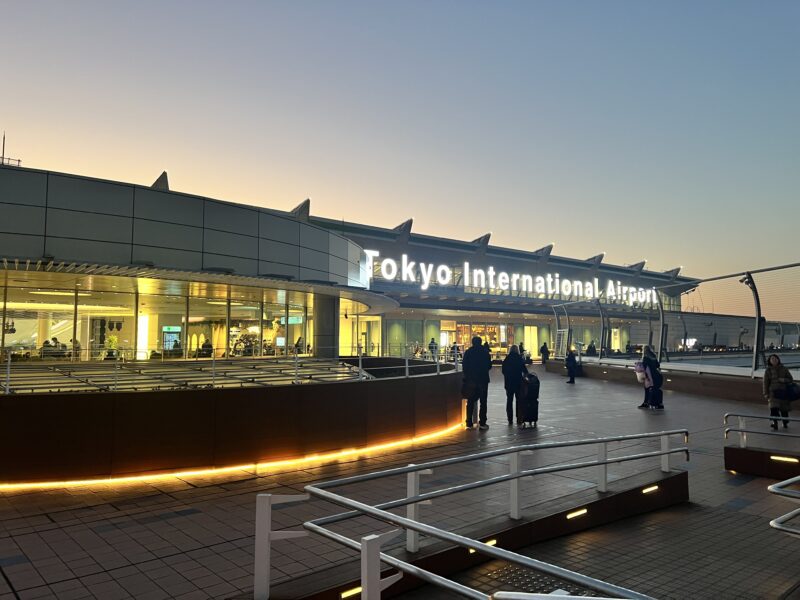
Haneda airport is one of two gateways of Tokyo along with Narita Airport. If you arrive at Hanead, you already have a great advantage of being close to Tokyo city center. It’s not a big airport and it’s easy to get into the city. This is the throughout guide to the airport.
Which Terminal You Arrive?
Haneda has three terminals – Terminal 1, 2 and 3. Basically, Terminal 1 is Japan Airline (JAL)’s domestic flights, Terminal 2 is ANA domestic and some International flights. Terminal 3 is all International flights.
| Terminal 1 | Terminal 2 | Terminal 3 |
| JAL Domestic | ANA Domestic ANA International (some, not all) | All International |
In higher chance, you arrive at Terminal 3 when you fly from other countires. If you use ANA, you arrive either at Terminal 3 or ANA’s Terminal 2.
In case you arrive by domestic flights from other airports in Japan, ANA arrives at Terminal 2, JAL arrives at Terminal 1.
International Arrival
When you get off the plane, you go through immigration, quarantine and custom. For sightseeing purpose, all you need is a passport. If you are from visa waiver country of Japan, you just need passport. If you are from the country Japan ask for visa, you can prepare well in advance to get visa on your passport.
Something recommended to fill up before the trip is Visit Japan Web. This is the site that let you prepare for immigration and custom. This is not compulsory, but saves your time at the immigration process. The system gives you QR code and you can scan at machine. You can also fill out yellow paper when you arrive at the airport, which is the conventional way.
Japan is going to introduce JESTA a pre-screening system of international travelers, but that wont be introduced until 2028 or so.
You go through quarantine first. If you have some physical concern from previous country you visited, it’s a must to drop by here. Otherwise, you can just walk through. After quarantine, you go through the immigration. It depends on the case, but usually you show your passport and answer some questions.
After immigration, let’s head to the turn table of baggage claim to pick your checked in luggage. If your plane arrives far away at Terminal 3 (which often happens for Delta flights), you might come out here faster than your luggage.
At the custom, you show the passport to the airport staff and time to time they ask you to open the suitcase. Unless you have any illegal products, you will be fine.
Not in Japan, but global warning that the number of portable battery you can bring to the airplane is limited, and no longer allowed to keep it in your checked in luggage. Along with this, some warning someone ask you to carry their portable charger saying they have more than 3. Never receive these offer and report, stay away from that peson. Make sure never carry any products that you are not aware of.
→ What you want to be careful for your luggage. What you cannot pack and something to avoid.
What You Can Do at Haneda Airport
After you exit to the arrival floor of Haneda airport, it’s time to head to your hotel or your destination of the day.
Before that, there are several things you might want to have it done at the airport. That is getting cash of Japanese Yen, and making sure you have some kinds of data connection to your smart phone.
Getting Cash
Haneda airport or any Japanese airport are might be a little different from airport in other countries. You don’t see many currency shops tenant lining up at the arrival gate. You only see one bank counter. Depends on the currency, but for the US Dollars, you might find this counter has the best rate than looking around better exchange rates in the city. You can also find Seven Bank ATM that you can get Japanese Yen using your cash card or credit card.
For more details, please check getting JPY Cash in Japan.
Find Connection to Your Smart Phone
Unless you get by just with hotel WiFi or public WiFi, it’s always convenient to have data connection to your smart phone. If your phone carrier’s plan doesn’t include data plans in Japan, you have several options to stay connected.
At the arrival floor of Haneda airport Terminal 3, you see several shops that has signs of “SIM”. You also see vending machine of SIM card. This is conventional physical SIM card that you need to insert into your phone. If you purchase at the store, they might be able to handle it for you. The most convenient way is to get eSIM to your phone if applicable. For iPhone, any iPhone after XS and after is eSIM compatible. You can apply online from your phone. There are tons of eSIM providers online, such as Holafly, Japan Wireless eSIM, Mobal.
If you like to have connection to your whole family with one device, you can consider portable WiFi. It’s a rental service that you can get mini WiFi router, and it’s a great option when you use PC outside the hotel or like to share your Internet connection. The con is you always have to be in the same place to stay connected. Japan Wireless Pocket WiFi.
→ eSIM vs Pocket WiFi – Which is better in Japan?
Lugguage Delivery
In case you travel far away in Japan in a few days, it might be a good idea to ship your luggage from the airport to the hotel. Japan has a trustable service that you can find your luggage a few days later at the destination. It’s recommended especially when you need to send ski or snow board, big multiple suitcases.
Other amenities
If you like to take shower, there is a shower room if you proceed to the right end of the arrival floor. For food options, there are many restaurants at departure floor.
Hotels at Haneda Airport
In case you arrive late, or have some physical concerns to continue travel after your long flights, you can also consider hotels at Haneda Airport for the first night.
Conveniently, Haneda has several airport hotels direcly conected terminals. T3 has Royal Park Hotel right next to the departure floor, and Hotel Villa Fontaine in Haneda Airport Garden that is connected with short walkway also from the departure floor. In case you arrive at T2, Excel Hotel Tokyu is also available even though a bit of walk to the other side of International area of ANA. As you don’t have to take shuttle and just walk to the hotel, you can use the restaurants and shops of the terminals during your stay.
| | Terminal 1 | Terminal 2 | Terminal 3 |
| Flights using | JAL Domestic | ANA Domestic ANA International (some use T3) | International |
| Hotel | | – Excel Hotel Tokyu | – Royal Park Hotel – Hotel Villa Fontaine |
Getting into the City
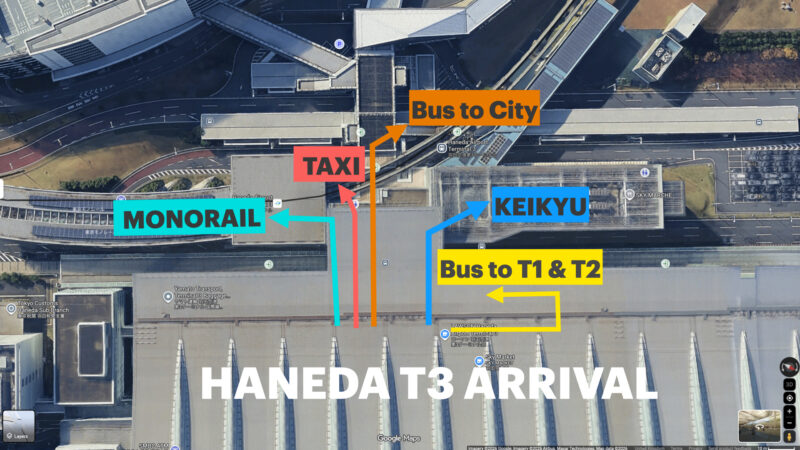
There are several public Transportations from Haneda airport to Tokyo city center. Depends on your hotel location and budget, you can head to the transportation you like. The terminal 3 has only one arrival gate, so it’s hard to get lost after your arrival.
Tokyo Monorail
Tokyo monorail is a service connects between each terminals and Hamamatsucho station in Tokyo city center. After leaving T2 station, it stops at T1, Seibijo station (mostly for busiess use), T3 and head to the city. Airport Rapids skips all station in between after T3, and brings you to the city cener in 13 minutes.
You only find local monorail that stops all stations during rush hour time, but still it only takes 18 minutes. The last stop Hamamatsucho has JR Yamanote line (line color : light green) that you can transfer to other parts of Tokyo, such as Tokyo station, Ueno, Shibuya, Shinjuku.
As Tokyo monorail is operated by JR East (former Japan National Railways based in Tokyo), you can use JR pass on this monorail. You can receive the pass at the machine or at the counter next to the gate of monorail. You can also purchase JR’s Welcome Suica – a physical prepaid IC card here. You can use your credit card to purchase it here, but topping up is only available by cash. Consider adding Suica on Apple Pay if you have iPhone for more convenience.
Keikyu
Keikyu is a train company runs train from Haneda Airport to Yokohama, and Shinagawa station in Tokyo. The line contineus from Shinagawa to further through subways, Keisei line to Narita Airport. It’s the best way to get to Shinagawa station to take Tokaido Shinkansen toward Kyoto direction, and if your hotels is along the line such as Ginza, Asakusa.
There is Terminal 1&2 station, and Terminal 3 station. It can take 13 to 18 minutes to Shinagawa, from T3 station. You can purchase ticket with cash, or you can also use touch payment such as VISA Touch. You can also purchase Pasmo (private railway version of prepaid IC Card) . Here, you can use Suica on your Apple Pay too.
Limousine Bus
There are limousine bus to Shinjuku station, and to the lobby of major hotels in Tokyo. It worth checking if you are staying at large sized hotel. It’s 1400Yen (about US$9) to Shinjuku area, and you can skip all the stress of transfering trains. There is a ticket counter right outside the arrival gate of T3. You also find ticket machine. After purchasing the ticket, you can proceed to. the bus lane.
Taxi
Next the entrance to the monorail, there is a escalator to go down to the taxi island. There is a staff after you go down, and direct you to the right taxi.
Going to another terminals / Arriving at Terminal 3 by taxi/buses
Terminal 3 has no streets facing departure floor or arrival floor. Streets are all under the arrival floor, and each lane has different escalator/elevator to go down. From the closest to the arrival gate, there is arrival lane of bus / taxis. This is the way to go when you take shuttle bus to T1 and T2.
For more visual understanding of the terminal, please check my video.