This post contains affiliate links. If you book through them, I may earn a small commission at no extra cost to you. Learn more.
Hello friends. When you buy a Shinkansen ticket for an ordinary car, you have two choices: a reserved seat, or a non-reserved seat. In Japanese they are called shiteiseki and jiyuseki. Most people book a reserved seat and pay a little more for a guaranteed seat. But non-reserved seats are not just the cheaper choice. Depending on where you get on, they can be easier and more flexible.
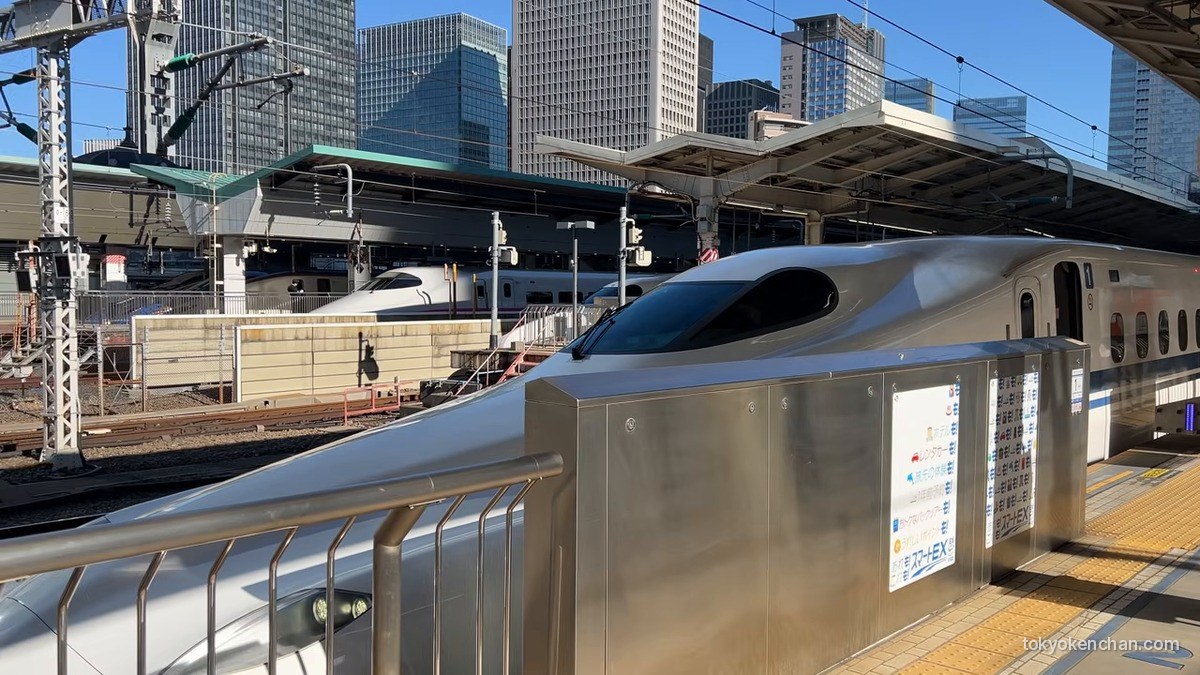
To see how it really works, I once rode four legs of the Tokaido Shinkansen only on non-reserved seats, between Tokyo, Okayama and Kyoto. This page is the short version of what I learned, plus the official rules you should know. For my full ride from Tokyo to Kyoto, with tickets, luggage and ekiben, see my first-timer guide to the Shinkansen. This page is part of my Japan Rail Tips list.
What is the difference between reserved and unreserved seats?
With a reserved seat, your train, car and seat number are fixed. You just get on and find your number, so you don’t have to rush to the station to line up. With a non-reserved seat, your seat is not decided. It is first come, first served. If you find an empty seat, it is yours.
On the Tokaido Shinkansen, the reserved cars and the non-reserved cars are separate. So once you sit down in a non-reserved car, nobody with a reservation comes and asks you to move. You can stay in that seat until you arrive. And if you don’t like the seat, for example it is loud or someone near you has a strong-smelling bento, you can simply move to another seat or another non-reserved car. That is something you can only do on a non-reserved seat.
On the Tokaido Shinkansen, Green Car seats, the first class, are reservation only. So the reserved or non-reserved choice is for ordinary cars.
Which cars are unreserved?
On the Tokaido Shinkansen, the non-reserved cars start from car number 1, so you usually walk to the end of the platform. According to JR Central, the typical non-reserved cars are cars 1 to 2 on Nozomi, cars 1 to 5 on Hikari, and cars 1 to 6 and 13 to 16 on Kodama. These can change, so always check the signs on the platform and on the side of the train.
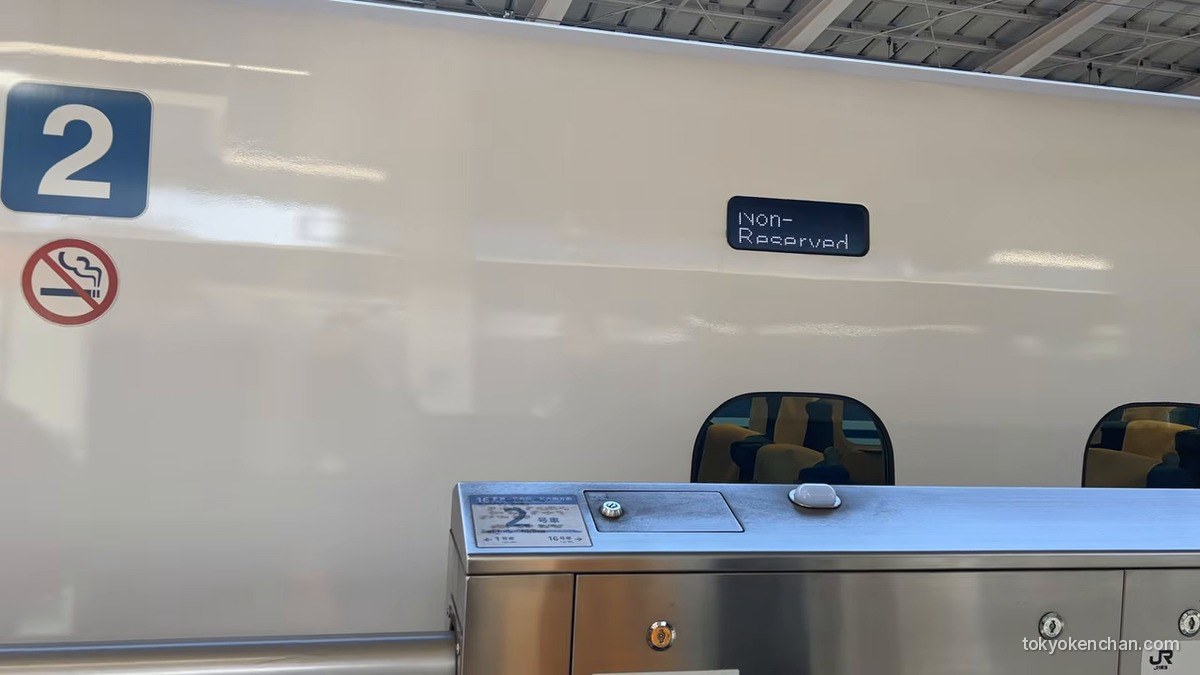
When I made my video, Nozomi still had three non-reserved cars. Now it has only two, so it can get a little busier than before. Hikari has many more non-reserved cars, which is why I like it as a backup. If you want to know how Nozomi, Hikari and Kodama are different, see my guide to Shinkansen train names.
Are some Shinkansen trains all reserved?
Yes. Japan’s Shinkansen is run by several JR companies, and the rules are not the same on every line. On the official car layouts of JR East, Hayabusa, Hayate, Komachi and Tsubasa on the Tohoku, Akita and Yamagata lines, and Kagayaki on the Hokuriku Shinkansen, are reserved seats only. Other trains on those lines, such as Yamabiko, Nasuno, Toki, Tanigawa, Hakutaka and Asama, have non-reserved cars, and which cars they are can vary by train.
So if your plan is to just show up and take a non-reserved seat, first check that your train actually has non-reserved cars.
Does Nozomi always have unreserved cars?
No. During the busiest periods, JR Central and JR West run every Nozomi on the Tokaido and Sanyo Shinkansen as all reserved. With a non-reserved ticket you can still get on a Nozomi, but only to stand in the deck area of an ordinary car. Hikari, Kodama, Mizuho, Sakura and Tsubame keep their non-reserved cars, but they can be very crowded.
In the 2026 fiscal year this covers Golden Week, Obon, the September holidays, New Year and some three-day weekends. The remaining periods are December 25, 2026 to January 5, 2027, January 9 to 11, 2027 and March 20 to 22, 2027. The dates are set each year, so please check the JR Central Nozomi page and book a reserved seat early if you travel then.
Is an unreserved seat cheaper?
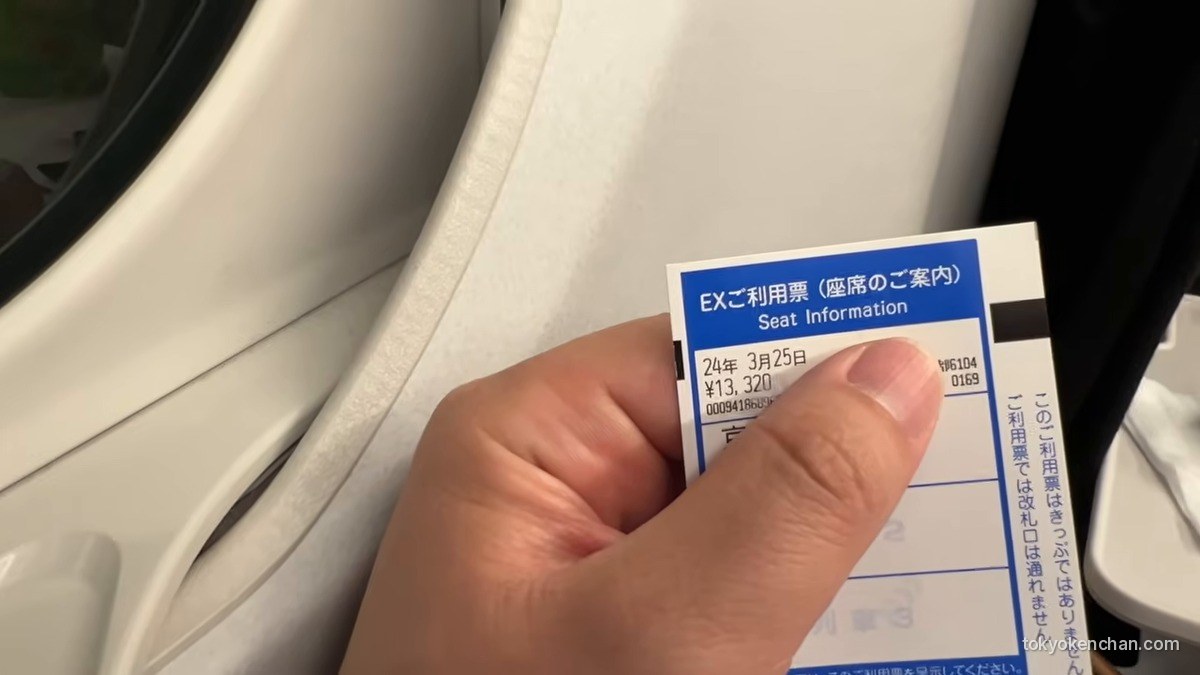
Yes, a little. For example, on Smart EX, the official online booking service for the Tokaido, Sanyo and Kyushu Shinkansen, one adult from Tokyo to Kyoto in the regular season is 13,320 yen for a non-reserved seat, 13,650 yen for a reserved seat on Hikari or Kodama, and 13,970 yen for a reserved seat on Nozomi.
Reserved seats also change with the season: on Smart EX’s price list, 200 yen less in the off-peak season, and 200 yen or 400 yen more at peak times. The non-reserved price stays the same. Prices at the station and on other booking services can be a little different, and fares change from time to time, so please check before you buy.
So the saving is small. If you want something better for not much more money, the Platt Kodama Green Car ticket is worth a look.
What should I know before riding unreserved?
Get on where the train starts
This is the biggest tip. On the Tokaido Shinkansen, trains start at Tokyo Station on the Tokyo side. On my first leg, I checked a train leaving in about 10 minutes, and there was only one person waiting at the door of car 2. The train left Tokyo Station almost empty on my car. I saw lots of people on the platform at Shinagawa and Shin-Yokohama, but not many got on the non-reserved cars. It was surprising, because I actually couldn’t get a reserved seat for the same time that day.
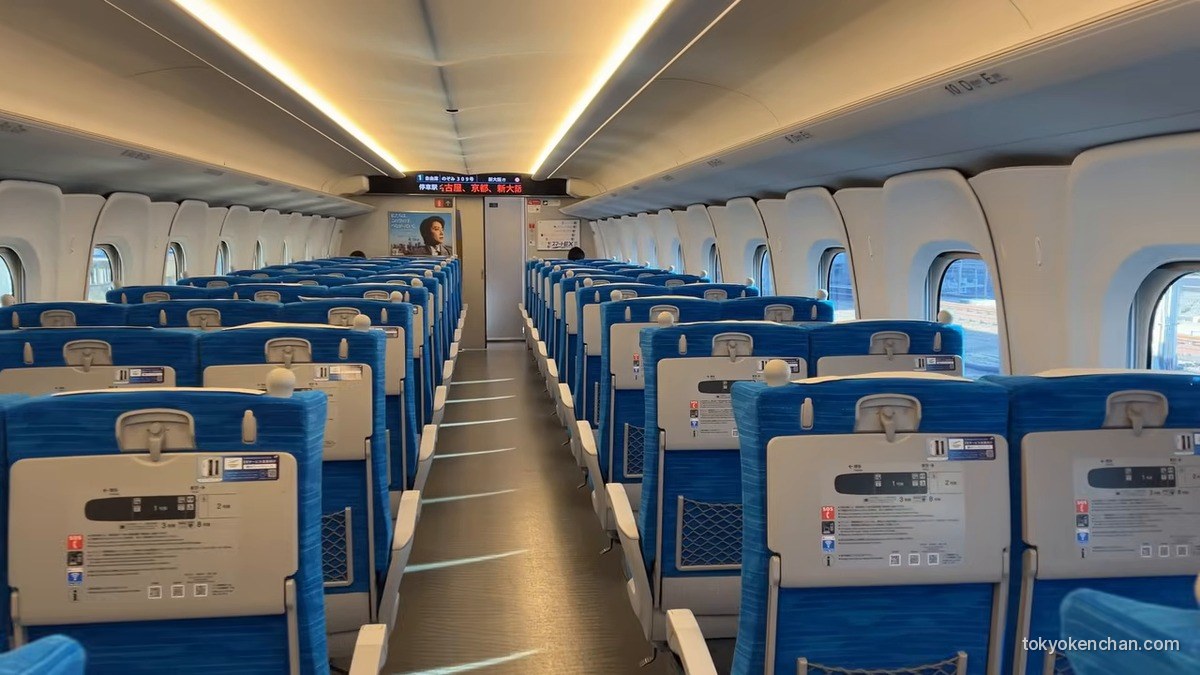
So from Tokyo Station, if you wait a train or two, you can get a seat almost for sure. From Shinagawa or Shin-Yokohama there is a small chance you may not, depending on the day. If you are staying in Tokyo, I recommend starting from Tokyo Station. My Tokyo Station guide can help you find your way inside.
Choose the right train and car
A few things helped me get a seat:
- If you are going to Nagoya, Kyoto or Osaka, take a train going to Shin-Osaka rather than one going on to Hiroshima or Hakata. It is usually less crowded.
- Car 1 is far from the stairs, so it tended to be less crowded.
- Count the people already lined up in front of you, and look inside the train. If it looks full, you can wait for the next one. On the Tokaido Shinkansen they come very often.
- If you get on in the middle, like Kyoto, pick a train that starts at the station just before yours. Coming back from Kyoto, I checked the JR Central timetable, picked a Hikari starting at Shin-Osaka, and got a seat in an empty car 1.
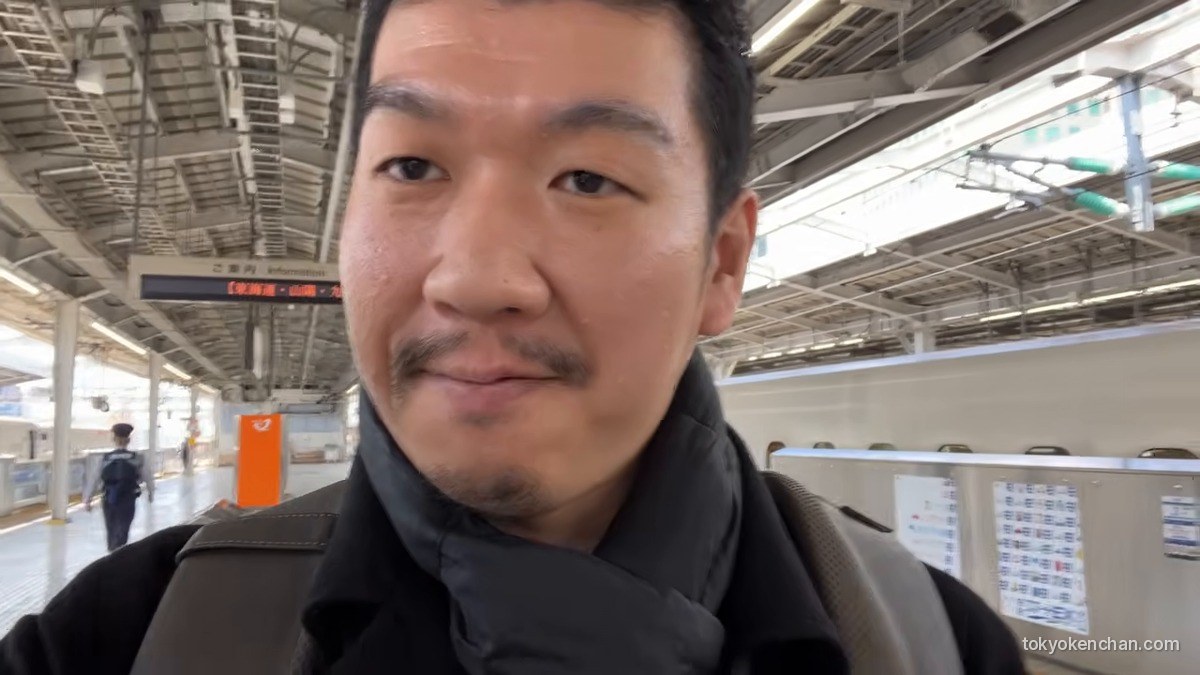
On another leg, I took a Hikari that started at Okayama. It was pretty empty, but the seats filled up at Shin-Osaka. That means getting a seat on that train from Kyoto would be almost impossible. So it really depends on where the train started.
Keep your ticket or seat slip
On non-reserved cars, the conductor comes and checks tickets one by one. They don’t do this on reserved seats unless you are in the wrong seat. If you enter the gate with a QR code or an IC card, a small paper slip comes out of the gate machine. Take it and keep it with you, so you can show it to the conductor.
Big suitcases
On the Tokaido, Sanyo and Kyushu Shinkansen, baggage with a total of three dimensions between 161 and 250 cm needs a reserved seat with an oversized baggage area, booked in advance. You cannot take it to a non-reserved seat. If you bring it without a reservation, there is a baggage fee of 1,000 yen. Viewers often ask me this in the comments, and my answer is always the same: officially, you cannot. Details are on the JR Central luggage page. Other lines have their own luggage rules, so check the company that runs your train.
Avoid the busiest days
I don’t really recommend non-reserved seats in the peak season. On a normal day, though, giving up the guaranteed seat gives you a lot of freedom. On the day I came back from Kyoto, I was at Toji Temple and wanted a little more time there, so I just went home later than planned. I could go to the station and get on any train.
What should I know before riding reserved?
If you get on at a middle station such as Shinagawa, Shin-Yokohama or Kyoto, if you travel at a busy time, or if you have big luggage, a reserved seat is the safer choice. With a reserved seat you can also choose your side. For Mt. Fuji, choose seat E in an ordinary car, as I explain in my Tokyo to Kyoto guide.
Booking sites differ by company. For the Tokaido, Sanyo and Kyushu Shinkansen, the official online service is Smart EX. According to JR Central, it lets you reserve seats up to one year before departure, for some seats and fares. I show how to use it in my Smart EX guide. JR East and JR West have their own official reservation sites for the lines they run.
What if I miss my reserved train?
With a regular ticket on the Tokaido Shinkansen, you can get on the non-reserved car of a later train on the same day, as JR Central explains. But this does not work with every ticket. In my experience with Smart EX, early-booking discount fares such as Hayatoku can’t be used on a later train, not even in a non-reserved seat, so check the conditions of your ticket. If you think you will miss your train, change or cancel your booking before it leaves. With a big suitcase you also cannot use a non-reserved seat on the next train, so you need to book a new seat with an oversized baggage area.
So which should you choose?
I always liked the reserved seat, because my seat is guaranteed and I don’t have to rush to the station. But I have started to change my mind a little, because I always start from Tokyo Station, where it is almost guaranteed that I can get a seat, especially on Nozomi with its frequent service.
So here is my simple answer. If you start from Tokyo or Shin-Osaka on a normal day and want flexibility, non-reserved is fine and a little cheaper. If you get on in the middle, travel at a busy time, ride an all-reserved train or carry a big suitcase, book a reserved seat. Rules and fares change from time to time, so please check the official pages before you travel.
Where to next
- How to Ride the Shinkansen: My Tokyo to Kyoto Trip and What First-Timers Should Know
- Shinkansen Train Names: Nozomi, Hayabusa, Kodama and the Rest
- Japan Rail Tips: all my train guides in one list